
Discovering Gros Morne’s enclave communities
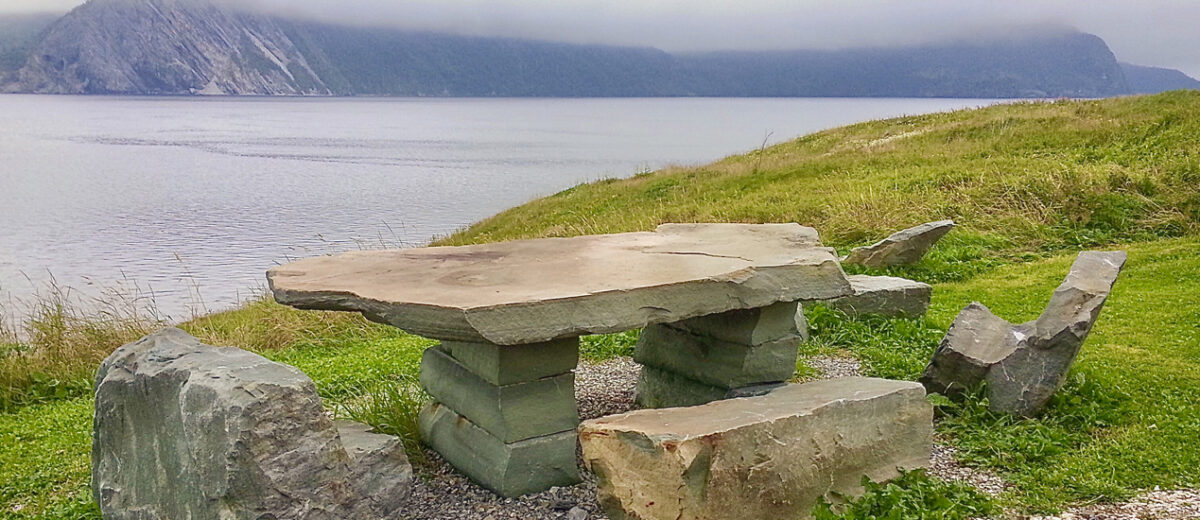
Chugging from Norris Point to Woody Point, N.L., the local water taxi carves a V into the mirror-flat waters of Bonne Bay. The wild, forested slopes of Gros Morne National Park’s tabletop mountains plunge into the fjord, protecting it from the open North Atlantic. To the northeast, the hulk of Gros Morne Mountain looms. To the southwest, the treeless plateau of the Tablelands rises in rusty red over the green shoreline.
The 15-minute crossing aboard the BonTours Breeze cuts off an hour’s drive around Bonne Bay’s east and west arms. It’s also a mini cruise through some of Atlantic Canada’s prime scenery. Norris Point and Woody Point, two of several enclave communities carved out of the park, add deep cultural and historical context to the grand landscape.
Norris Point is a loose collection of homes, inns, restaurants, and quays around a horseshoe peninsula punctuated with a rocky hill. The water taxi docks near the Bonne Bay Marine Station where an aquarium is home to species from the depths of the fjord — lobster, crab, starfish, and grimacing Atlantic wolffish.
Woody Point is a seaside village with a string of former fishing sheds transformed into a handful of bars and restaurants. The beating heart of this tiny hamlet is the Woody Point Heritage Theatre, a handsome, two-storey hall that hosts a Newfoundland fixture, the annual Writers at Woody Point festival. Every year since 2004, literary giants have headlined the festival, including Margaret Atwood, Michael Crummey, and Alexander McCall Smith, plus musicians like Bruce Cockburn, Gord Downie, and Alan Doyle.
In 2016, organizers created a spinoff called Comedy at Woody Point where big names like Cathy Jones, Shaun Majumder, and Ron James provoke belly laughs. Majumder credits his upbringing in rural western Newfoundland for his folksy, grounded sense of humour.
“If you’re growing up in rural Newfoundland, you don’t have the influences you have in Toronto in terms of size, consumerism, and having the same channels as everybody else,” says Majumder. “But you go outside and there’s a moose in your back yard. It’s a different kind of upbringing.”
Similarly, Kevin Blackmore, lead of the Newfoundland musical comedy group Buddy Wasisname and the Other Fellers, says, “I spent a lot of time in the woods with my buddies. 360 degrees around you is woods, lakes, and rivers for hiking, fishing, camping — anything that would carry us out to the woods.”
It takes ingenuity to entertain oneself in small, isolated Newfoundland communities, according to Blackmore. “I remember screwing a doorstop on my mandolin. It made wonderful punctuation at the end of a phrase. I screwed a bicycle horn to the bottom of that.” Of the self-deprecating, homemade humour his band is known for, he says, “You’re having fun within a culture because you’re part of it.”

Across Bonne Bay is Rocky Harbour, the largest of the enclave communities, where another musical comedy group is a fixture at the Ocean View Motel. The Ocean View’s Anchor Pub is home to the thrice-weekly performances by the Anchors Aweigh Band. Lurching from toe-tapping dance tunes to heart-clenching ballads to one-line zingers, the band puts on a rollicking show. Like Blackmore and his doorstop-bicycle horn-mandolin, the Anchors Aweigh Band employs a homemade instrument in its self-deprecating musical humour: the ugly stick.
Tour operators Under the Stump include an Ugly Stick 101 class on their all-terrain vehicle tours. A classic Newfoundland homemade musical instrument, the ugly stick is a wooden handled mop or broom with sets of bottle caps, tin cans, bells, or other noisy accoutrements. The mop end of this “ugly” percussion instrument is often dolled up to resemble a face. The whole apparatus is banged on the floor in time with the music.
There’s more original Newfoundland humour and culture found in local shops. One Rocky Harbour store advertises liquor, fudge, and crafts, pulling in many curious passersby. Chocolates flavoured with Screech, a dark rum unique to Newfoundland, share the shelves with jams and other preserves made from foraged local fruit like partridgeberry, bakeapple, and crowberry, all made by a business called Dark Tickle. In Newfoundland, a “tickle” is a narrow passage of water.
There’s more to learn about Newfoundland through its food at the Sunset Café. In the local dialect, Cod au Gratin, a menu favourite, is pronounced cod-a-GRAT-n. The cod fishery drew settlers to this island and served as the backbone of the economy for close to 500 years. While the commercial fishery all but died out in the 1990s with the collapse of cod stocks from overfishing, there’s still a small, local fishery. Topped with cheese, baked in a creamy sauce, and given a swanky French name, Cod au Gratin is fine eating.
Today, Rocky Harbour owes much to the creation of Gros Morne National Park, now a World Heritage Site. Founded in the 19th century as a fishing village by French fishers and English merchants, the community grew quickly from 35 in 1874 to 357 in 1921. Although growth stagnated in the early 20th century, the park’s creation in 1973 and the tourism related businesses that sprung up gave the town a second growth spurt, reaching a population of nearly 1,000 by 2021.
Green, grassy grounds at the edge of town are studded with bone-white headstones, which testify to the depth of settler history on these shores. On the face of every stone, epic stories of whole lives are contained within a few carefully selected words. One reads, “In loving memory of William Young, lightkeeper, beloved husband of Esther Young, died Aug. 14, 1941, aged 73 years.” And on the next stone from just three months later, “In loving memory of Esther Young, beloved wife of William Young, died Nov. 16, 1941, aged 73 years.”
Family histories encapsulated in a few words, a water taxi, a writers festival, foraged berry preserves, ugly sticks, and musical comedy. These unique Newfoundland traditions define the lively enclave communities set among the wondrous landscape of Gros Morne National Park.
Recipe