
The technical and the elemental — a week at the Nova Scotia Seafood Academy
In Wolfville, where the classroom windows open wide to the Bay of Fundy, its tides breathing in and out like some vast animal, I spent a week at the Nova Scotia Seafood Academy. I arrived intending only to gather a story about a new series of courses shaped by Chef Peter Dewar and carried forward by Devour, the food and film festival founded by Lia Rinaldo and Michael Howell.
It’s one thing to eat for a living, to slip behind the curtain of kitchens and orchards and write of the hands that feed us. It’s another thing entirely to stand at the table as a student, knife in hand, listening to the gospel carried in the voice of a seasoned chef. The lessons here weren’t only technical but elemental: fish is to be touched with gentleness, love and respect are the marrow of every dish.
From festival to classroom
For 15 years, Rinaldo and Howell have turned Wolfville into a destination for those who believe food tells our most human stories. With Devour, the food film fest has married cinema and cuisine, offering workshops, dinners, and screenings that draw chefs and storytellers from across the globe.
Now, with the Nova Scotia Seafood Academy, that same spirit has found a home year-round inside Devour Studios, perched above the Bay of Fundy.
“Our inspiration comes from our love for Nova Scotia’s bounty of amazing seafood and the growing demand for fun, hands-on learning experiences,” says Rinaldo. “After hosting successful culinary workshops during the week of Devour for 15 years, we saw a great opportunity to offer programs that not only boost cooking skills but also celebrate our local seafood culture.”
There’s a teaching kitchen, bright with steel and light, where every window frames the living source of the ingredients being prepared. “The Bay of Fundy is well known for the seafood landed locally, Digby scallops, Halls Harbour lobster, halibut from the bay,” says Howell. “Your connection to the sea is felt at every turn, and the Devour Studio provides a state-of-the-art kitchen and an atmosphere that enhances the experience. Positioned in the heart of Wolfville, it’s a hub for culinary tourism, accessible to both locals and visitors.”
The goal is immersion. “It’s about building community and celebrating our culinary heritage while promoting sustainable practices,” says Rinaldo. “Participants learn cooking techniques and discover the origin of their seafood. That leads to more mindful cooking and a greater appreciation for the ocean’s resources.”

The hands that feed
Chef Peter Dewar, from the faculty of culinary management at Nova Scotia Community College Kingstec in Kentville, N.S., shaped the curriculum, and speaks with the patience and precision of someone who has spent a lifetime both teaching and learning from the sea.
“The idea behind the seafood academy was to create a bridge between our local waters, our community, and the next generation of cooks,” says Dewar. “I wanted students to not only learn how to cook seafood, but to understand where it comes from — the people who harvest it, the ecosystems that sustain it, and the responsibility we have to use it wisely.”
Every fillet, every oyster shucked, every mussel cleaned is also a lesson in stewardship. “Nova Scotia has incredible seafood,” Dewar continues, “but too often we send the best of it away while local cooks and consumers don’t get the chance to explore its full potential. The Academy fills that gap by creating a space where education, sustainability, and industry come together.”
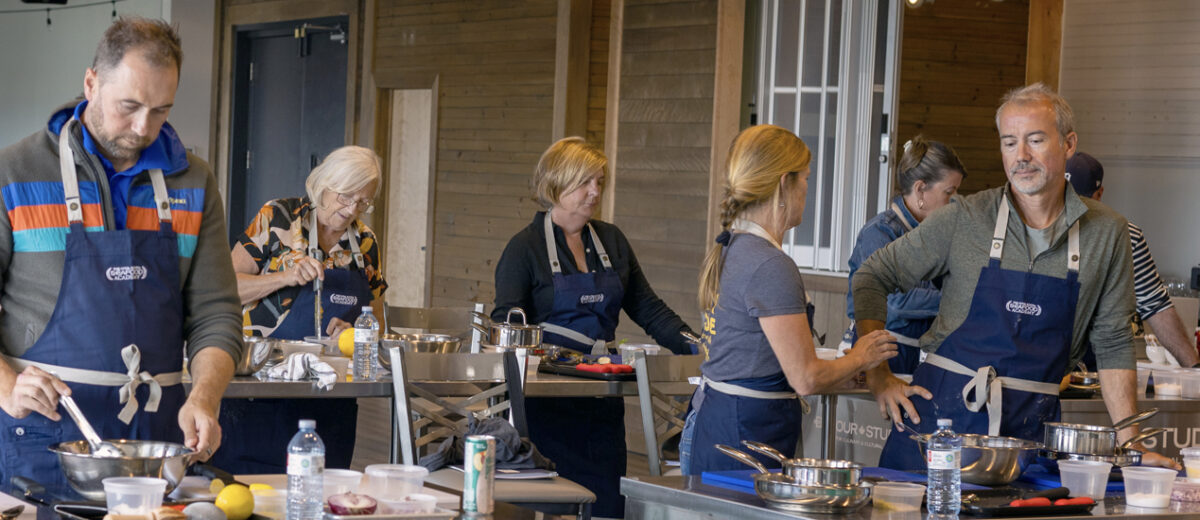
The philosophy played out in gestures both grand and small. Students bent over cutting boards, coaxing fillets from flounder with reverence. Dewar demonstrated how to score a fish’s skin to keep it from curling in the pan, then paused to tell the story of the harvester who caught it that morning.
“The setting shapes everything,” says Dewar. “When you look out the windows of the Devour Studio, you see the Bay of Fundy — the world’s highest tides, working boats, and the people who depend on that water. It’s a living classroom. That view constantly reminds us that seafood isn’t just an ingredient. It’s part of a story that begins long before it reaches the plate.”
Lessons of the tide
By week’s end, my own hands knew more than my notebook ever could: how to free flesh from bone — whether flat fish or round fish — and the deeper learning that in the kitchen, as in the tide pools, every gesture is a kind of dance.
At day’s close, we set aside the knives, untied aprons, and reset the long table for the feast. We ate the lessons of the day: lobster bright with seawater, clams tangled with chorizo, mussels steeped in cream and wine, scallops seared to a golden edge, smoked salmon with apple, gravlax dusted with dill. Each dish paired with Tidal Bay wine, its minerality and salt-kissed brightness like the ocean in our glasses.
Outside, the tides continued. Sweeping in, sweeping out.
Dewar sees this rhythm as a metaphor for the academy’s future. “The vision is to grow the academy into a hub for seafood education in Atlantic Canada — a place where students, chefs, fishers, and community members come together to learn, collaborate, and innovate. We’ll keep accessibility and sustainability at the core.”
He’s already looking ahead to the next phase: advanced courses, Indigenous knowledge, aquaculture studies, and field visits to local fisheries. “It’s about building a stronger seafood culture that benefits both our economy and our environment,” he says.
Rinaldo echoes that hope: “We want the Academy to become a cornerstone of culinary education and gastronomic travel in Nova Scotia, something that inspires a new generation of cooks and seafood lovers. It’s about celebrating our heritage while equipping people with … skills and knowledge to promote sustainable seafood practices.”
The sea within
On my final day, the water was low and the mudflats shimmered bronze. I lingered by the window, thinking of the hands that bring the ocean to the table — the harvesters, chefs, teachers, students — and the thread that connects them. The tide was turning again, rushing back toward shore.
What we practised in the kitchen was the same truth the bay has spoken for centuries —generosity is endless when met with reverence, and every meal, like every tide, is a gift returning to shore.
Recipes