

Aunt Janice’s handmade cookbook holds much more than precious recipes.
Aunt Janice’s handmade cookbook holds much more than precious recipes.
Editor’s Pick
Searching for a holiday gift idea?
A handmade cookbook like Aunt Janice’s leaves a lasting legacy of food—and family—memories.
Over the years, I’ve acquired many cookbooks—too many, perhaps, ? to be practical. Thanks to mid-life memory loss, it’s become almost impossible to locate a single recipe within my cookbook collection, not to mention how challenging it is to find one among the countless magazines and clippings I’ve saved. There is one book of recipes, though, that is never hard to find—it’s always front and centre in my collection.
When I was 16, my Aunt Janice gave me a slender, hand-made cookbook for Christmas. She chose 13 of her favourite recipes and printed each one in blue ink on an index card. Then she bound them with a black coil and sewed fabric on the end cards, to make covers. This cookbook, now tattered and stained, is the smallest book I own, but the most valuable. If there were a raging fire in my house, I would be tempted to rush in to save it.
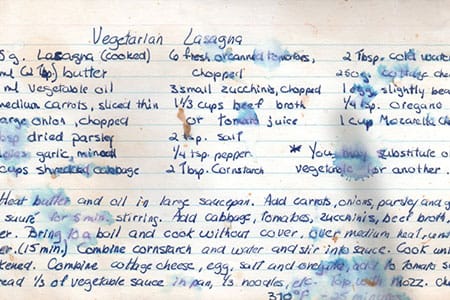
More than recipes are at stake here. My cookbook has served friends and family for more than a quarter of a century. Through birthdays, Sunday brunches, student dinners and coffee with friends; on the East Coast, the West Coast and at places in between—my cookbook has been with me through it all. It is my memory keeper and my time machine.
Consider the recipe on page two for Vegetarian Lasagna (pictured above). One look at that faded, oil-stained page and I am back in my student kitchen in 1983. My cotton skirt brushes against my ankles as I dance to Neil Young, singing, “Comes a time, when you’re driftin’.” Those were the days of a big rental house, long summer nights, hiking and folk festivals. More leisurely days, to be sure, with time enough to spend all afternoon hand-chopping onions, garlic, carrots, cabbage, tomatoes, eggplant and zucchini for the lasagna.
Every first cookbook needs a rite of passage recipe, and my aunt was not remiss in that department. My cookbook features the ubiquitous ’70s recipe: Tuna Casserole. To be fair, my aunt’s recipe strives for something more wholesome, with brown rice and chopped vegetables added to the mix. The first tuna casserole I made, though, was definitely the standard version—canned tuna, noodles, cream of mushroom soup and cheese, with chips on top.
In high school, my girlfriend and I made it as a special Christmas dinner for our boyfriends. We set the table with my mother’s finest, turned the lights down low, lit the candles and waited while Dream Weaver played in the background. Finally, enter la pièce de résistance: the casserole, bubbling at the edges, wearing a crown of lightly browned chips and glowing in a soft circle of candlelight.
Who knew a tuna casserole could be so romantic?
The last recipe in the cookbook is really where my love of food and cooking all started, though. In English, the pie’s name doesn’t do it any favours, which is unfortunate because “Pâté aux Coques,” as it’s called in Acadie, is comfort food at its best. My mother-in-law, who hailed from the prairies, called it “Clam Chowder Pie.” Definitely a nicer ring in English, and if you’ve never tried clam pie, it gives a pretty good idea of what you’re about to encounter.
Opening the cookbook to this page is like opening the door to 117 Shirley Avenue, in Moncton. My grandparents lived there for as long as I knew them, and growing up, our family visited weekly.
The memory is vivid: in the porch, I recall being kissed first by my grandfather and then my grandmother, who had come out of the kitchen, wiping her hands on her apron. We sat in the living room, a glass bowl of Ganong pink peppermints on the coffee table.
My grandfather was telling us all he knew about lobster, which was considerable, given that he was not a fisherman. The topics were familiar—best waters for lobster, best season to buy, when not to buy because you would get cheated. At that point, I think my grandmother had heard enough; she went back to the kitchen and started cooking. I followed her there and sat at her tiny table.
My grandmother loved to feed people and she produced some wonderful food from her small, immaculate kitchen—pea soup, poutine à trou, rappie pie and the best clam pie you ever tasted.
I watched my grandmother expertly work pastry into a pie shell and then fill it with a thickened sauce of clams, potatoes and onions. I helped her clean up and get a salad ready as her small house filled with the aroma of seafood pie.
Last Saturday, as I was waiting for my own clam pie to cook, I flipped through my little cookbook. I started thinking about all the kitchens I’d been in—my mother’s, my aunt’s, my friends’ and my grandparents’. I thought about all the good times and the good food we had shared together. Time and distance separate me from most, but I do have my Aunt Janice’s mighty gift. With it, I can unlock any kitchen from my past and stop to visit for a while. I wonder what’s cooking at 117 Shirley Avenue?