
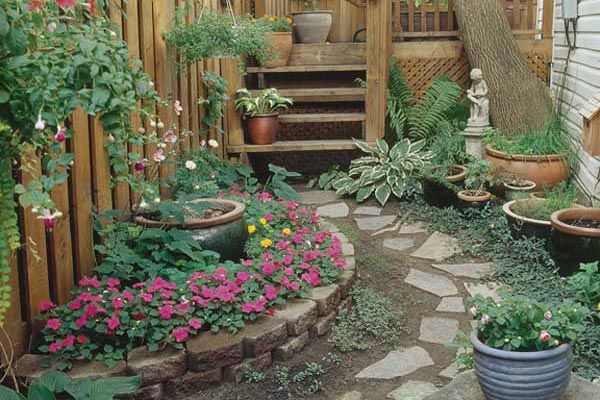
Remember the lottery commercial on TV that had a couple proudly showing off their "garden" on a minute balcony in Toronto? While that garden was laughable, it is a reality that not all green thumbs are blessed with an abundance of space to garden in.
Use your roof, deck, or tiny yard to its full potential.
Remember the lottery commercial on TV that had a couple proudly showing off their "garden" on a minute balcony in Toronto? While that garden was laughable, it is a reality that not all green thumbs are blessed with an abundance of space to garden in. Atlantic Canada is no exception. Some of us have only modest yards (OK-postage-stamp sized for some!), while others have none at all, living in condos, duplexes, or other housing situations where the only outdoor space available is a balcony or deck.
Some people would like also like to garden at their cottage, where there may not be much cleared land to work with. If this is you, please don’t despair! There are plenty of options for gardening in a small space, whether it’s a tiny yard, a deck, balcony, or even a rooftop. There are actually advantages to having a small garden. You don’t usually need help doing the chores of watering, weeding, fertilizing, deadheading and such. Many older or physically disabled people, who can find extensive garden tasks overwhelming, are able to continue enjoying plants in a scaled-down garden.
In talking to landscapers around the region, I’ve learned that it can be trickier to design a small garden than a larger one. There isn’t a lot of room for error, and every bit of space (and every plant!) has to count. When dealing with clients, professional designers come to the homeowner’s site and assess what’s there for space. Then they ask the client about what they like, dislike and want. If you’re planning your garden on your own, ask yourself similar questions. What will you use the garden area for? What sorts of plants do you like to grow: flowering shrubs and perennials, annuals for container plantings, vegetables and small fruits, herbs? Is it a spot for relaxation or entertaining, a place for children to play, an extension of your home or work office? How much money are you prepared to spend on hardscaping, plants, watering considerations, and accents? How much time are you able (or do you want) to spend working in the garden? What types of challenges could your location pose? On a rooftop, for instance, you may only have available sunlight from one or two directions, depending on what other buildings surround your dwelling. It can also be hotter and windier up there.
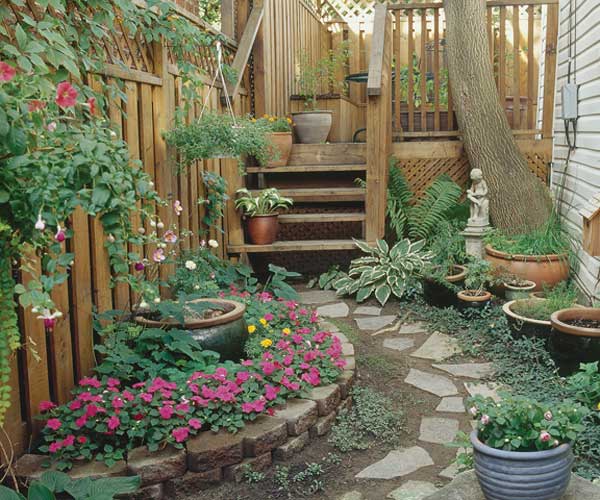
While there are unique challenges to developing a small garden, there are also great garden aids available. Garden companies are responding to the increase in small-scale gardening with a whole host of great products, from soil mixes that include fertilizer and moisture-holding compounds to irrigation systems to specialized planters, plant supports and other wonderful (and labour-saving) items.
Once you’ve committed yourself to starting your fabulous small-scale garden, consider the following tips:
1. Create living screens. These are great if you’re going to create a garden in a city subdivision, on a balcony or rooftop with walls or other nearby borders that aren’t terribly attractive. Soften the edge of your garden by using a climber such as Boston or English ivy along the border, a hedge of compact shrubs, or even a line of ornamental perennial grasses. The latter will create a softly flowing hedge that needs minimal care-no pruning other than cutting back the foliage in the spring.
2. Choose compact cultivars of plants you like. You’ve gotta love plant breeders. Recognizing that not all of us have an acre (or seven) to garden on, they’ve been industriously breeding cultivars that are smaller in size, including vegetable varieties. Depending on your garden size, you can even have small trees, grown in containers and pruned to keep their growth in check. Perennials will often have ‘Compacta’ in their name to indicate a smaller growth habit; shrubs may have ‘Compacta’ or ‘Nana’ to indicate dwarf size. Do avoid perennials with a spreading habit, such as ground covers and perennials that spread by rhizomes, unless you’re planting them in a container where you can curb their enthusiasm.
3. Containers are a great way to garden without a yard. The trick is to select the appropriate container for what you want to grow. A dish garden of cacti, succulents and alpines doesn’t have to be very large or deep, whereas if you’re planning to grow a few vegetables or containerized shrubs, you’ll want there to be room for root growth and development. If you’re worried about large urns and planters being too heavy and difficult to move once planted, place empty plastic pots upside down in there first, then pour the soil mix in. Using less soil means less weight.
4. Go vertical-nowhere is it more useful than in a small garden. Many vegetables will happily grow up a trellis or down from a hanging planter, including squash and cucumbers, pole beans and tomatoes. Even strawberries will grow in a hanging basket, and there are wonderful annual flowering plants for vertical garden effects.
5. Plan from the ground up. Whether you have an actual in-ground garden bed or are container gardening, make sure you have good soil, well amended with compost and organic fertilizer. Some gardeners are now adding products to their potting mixtures that help retain moisture and reduce watering, and there are also timed release fertilizers that can be added into the potting mix.
6. Choose the best quality materials you can afford. It’s a good idea to avoid using too many different hardscaping materials – such as decking, gravel, slate or bricks – in a small space, but no matter which you choose, always choose quality. With a smaller garden, the expense of building a deck or stone pathway is significantly lower than in a large, sprawling property, so you can invest in good slate or cedar or pea gravel to develop the hardscape feature you choose.
7. Add garden art and other accents. Often a carefully selected piece of garden art or other accessory can make a garden’s appeal even greater. But this is a situation where you may want to exercise restraint, indulging in one nice piece: a statuary, an artisan-created birdbath, a trellis, etc. Too many accent pieces in a small garden will make the site appear cluttered rather than restful and well thought out.
Some innovative small gardeners will use trompe l’oeil to fool the eye into thinking the garden is larger than it really is. This can be achieved by setting a mirror into a wall or end of the garden area, so that it creates an illusion of depth. Water features can also do this if designed and installed correctly, as the sound of running water creates a feeling of size (and tranquility) in your garden.
8. Don’t underestimate convenience. Remember that if you’re planting on a balcony or a rooftop, you might have limited access to the materials you’ll need. Everything from soil and tools to pots and plants will have to be hauled up to the site. Make sure you have an adequate source of water nearby, as no one wants to haul gallons of water, even when assisted by an elevator-or a long-suffering spouse.