
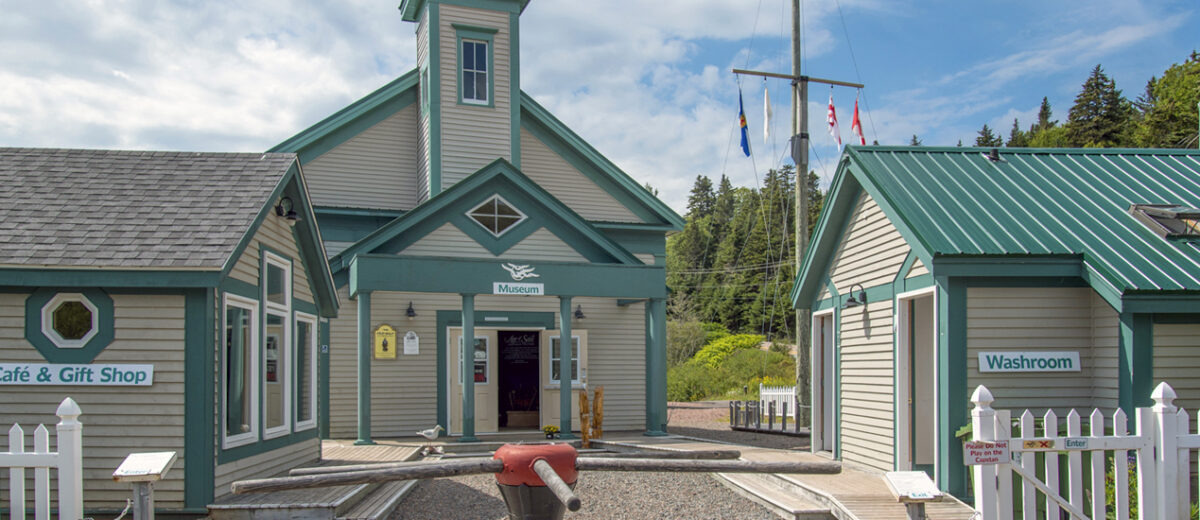
The Age of Sail Museum in Port Greville takes you back to an era when Nova Scotian ships ranged over the seven seas
For centuries, many of the villages on the north shore of the inner Bay of Fundy in Nova Scotia, were more easily accessed by sea than by land. A reminder of that era, the Age of Sail Museum in Port Greville isn’t hard to get to by road, but remote enough to give a sense of isolation.
Driving west on Route 2, you feel a presence that’s more than the surging tides and the shifting winds. Dinosaurs once roamed along this shore, which is sacred to the Mi’kmaq, whose god Glooscap was a naturalist, a shapeshifter, and a storyteller.
Beyond Parrsboro, the road snakes along the cliffs to the Age of Sail Museum, its wooden buildings guarded by a lighthouse moved up from the cliffs below, a giant anchor, and a capstan used to pull up anchors from the deep. Just below, a tidal river flows down to the entrance of the harbour that launched wooden ships for centuries. The museum is open daily in July and August, and Thursday to Monday from May through October.
Curator Oralee O’Byrne tells visitors about the age of sawmills and wooden ships, chats with patrons, and glides back and forth between the on-site café at the museum next door. While the museum has a board of directors and dedicated volunteers, O’Byrne is the heart and soul of the place. In 1982, she moved to Port Greville at age 15 from Alberta when her father Ross (Keith) Colins came back home. Her parents co-founded the museum, which opened in 1994.
After exploring the gift shop, we enjoy a lobster roll with the meat flowing onto the plate and the waffles with fresh strawberries and whipped cream. Two volunteer carpenters sit nearby. One is the treasurer. Together, they are finishing the exterior of the new building, designed in the shape of one of the last wooden ships built in the area.
“I like the pace here,” says O’Byrne. “I’m an introvert so isolation doesn’t bother me. People are more real, more down to earth. You get to know your neighbours.” The population of Port Greville was once mostly working-class people, she says. Now it’s mostly retirees and seniors.
Inside the main building, you feel the presence of the original Indigenous inhabitants and the early Europeans, a time when almost everything came from the forest, including the wood for the first sawmills and the shipyards that grew along the shore. Surrounded by images and models of sailing ships of all sizes, there are sextants used for navigation, logbooks, the clothing of the day, a dory, tools, a working blacksmith shop, a hand-powered saw, an early radio, and a harmonium taken from a ship. A model of an old woman sits beside a real stove surrounded by her kitchen ware.
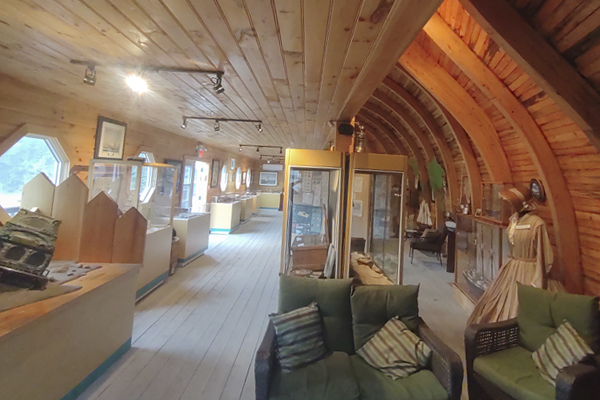
building is based on the design of a wooden ship built in Great Village.
The new building beyond is designed in the shape of a historic sailing vessel. It contains models, images, and artifacts of historic ships connected with Nova Scotia, including the Glooscap, built at nearby Spencer’s Island in 1887; the Mary Celeste, found abandoned and drifting in the North Atlantic in 1872; the Spray, the sailboat used by Joshua Slocum of Brier Island, N.S., to make the first solo circumnavigation of the Earth in the 1890s; and the Titanic, the largest ship afloat when it went down in April 1912.
The history of sawmills parallels that of shipbuilding. The first European mill in what is now Nova Scotia was built in 1605 at the French settlement at Port Royal. By 1871, there were 1,144 mills, which shrank to 720 by 1953 and to less than 100 today, of which many are small family-owned operations. Meanwhile, 723 ships were built on the shoreline between Parrsboro and Eatonville alone.
Built in 1854 as a Methodist church, the museum’s main building was originally in nearby Greville Bay. A local shipbuilder moved the building to use as a sail loft and later donated it as a community hall. It was taken apart once more and moved to the site of the proposed museum. In 1992, the building was donated to the development society. Workers dismantled it again and moved it two kilometres to the present site.
Building ships from wood cut from the forest is partly science, partly art. Imagine sailing them by lead line, telescope, and sextant. The tides come alive. Even in summer the air is brisk, keeping your balance an adventure. You step outside the museum, smell the salt air, feel more alive.
Recipe