
Thanks to a frustrated mechanic in Newfoundland, heating your home has just become less costly and more environmentally friendly. "I was paying diesel rate for electric heat," says James Meaney.
Converting energy from the sun into heat for the home is catching on.
Thanks to a frustrated mechanic in Newfoundland, heating your home has just become less costly and more environmentally friendly. "I was paying diesel rate for electric heat," says James Meaney. "Times were tough and I had my power cut a couple of times. That kind of ticked me off." Meaney didn’t sit and curse the cold; instead he put his mechanical mind to work to develop a solar panel that would produce heat from the free energy of the sun.
After tinkering and testing, Meaney settled on recycled aluminum cans as the core of the unit, which uses sunlight to heat air. Although the Cansolair Model RA 240 Solar Max is low-tech in that it doesn’t convert solar energy to electricity, nor does it use water as a transfer agent, as other solar solutions do, the price is appetizingly low: one unit is $2,100. The design was good enough to win Meaney the regional 2003 Canadian Innovation Award from the National Research Council’s Industrial Research Assistance Program and the Canadian Manufacturers & Exporters Association. The inventor has formed a company called Cansolair Inc. that now manufacturers the Model RA 240 Solar Max in Dildo, NL, and distributes them through a network of 150 dealers in 10 countries. The growing trend toward renewable energy has opened up a world of opportunities for homeowners as well as manufacturers and suppliers.
Meaney created the Consolair panel by stacking the cans in rows, then topping the assembly with a curved sheet of polycarbonate, which is UV-stabilized and virtually unbreakable. The cans are finned to allow air to flow through and painted black to keep the heat in. The 4-foot x 7-foot unit, which is attached to a wall that gets the most sunlight, uses a fan and ducting near the floor to draw cold air from the room; the air is then warmed in the sun-drenched cans. Once the temperature inside the unit reaches 43.3°C, the fan pushes the air back into the room through a vent near the ceiling. Installation of the unit takes a mere two and a half hours.
One panel can heat from 1,000 to 1,600 sq. ft of living space with as little as 15 minutes of sunshine each hour. The air flow rate through the panel core is 90 cu. ft. per minute and the temperature rise can be from 10° to 37.7°C. These units can be used for residential or commercial space heating, crop or process drying, or even to heat water for domestic or thermal storage purposes with the use of an exchanger. Karlena Johnson, of Mi’kmaw Alternative Energy in Whycocomagh, NS, uses and sells Cansolair panels. After paying for four tanks of oil in one season to heat her 26 x 40-foot home, she went looking for alternatives. "Solar heating is a clean fuel," she says. "It has no fumes, no fuel price fluctuations and each unit prevents two tonnes of carbon dioxide going into the atmosphere each year as compared to burning fossil fuels."
Johnson now has two units on her house, each of which saves her about one tank of oil. She also insulated her basement, which reduced total consumption to one tank of oil per season. Cansolair complements the existing system, raising the temperature so the oil furnace thermostat doesn’t kick in as often. Johnson says the fan requires 31 watts of electricity per hour but in the event of a power outage she uses a power source from Canadian Tire that works well.

Since the Cansolair panel requires sunlight, it’s listed with RET SCREEN software, developed by the National Research Council. The free software uses a NASA weather database to allow the user to do a site assessment based on climate conditions, location and energy consumption, to judge the feasibility of the addition of alternate energy sources.
Whether you’re ticked off at energy prices or trying to help the planet (or both), a site assessment is key to creating an efficient alternate energy heating system. When John Ross of Sunross Energy Systems Ltd. in Cleveland, NS, started building his modest dream home, he hired solar architect Don Roscoe, who visited the site to determine the best positioning. The house, which won the 2004 Energy Efficiency Award from Natural Resources Canada, faces south and because it’s by the water, it gets a cooling effect in summer. In winter, the ice and snow on the river reflect additional light into the house. The design is intended to make use of passive solar heat with the size and placement of windows, and open-concept kitchen, dining and living rooms. An in-floor air system circulates that passive heat gain to the rest of the house.
Before adding solar, Ross, a certified installer of solar and wind products, says it is important to know you are dealing with a certified installer (the Canadian Solar Industry provides certification courses, as do some community colleges). "The next step is to install a solar domestic hot water unit," he says. "Thirty per cent of your household energy is used to heat domestic hot water. A solar hot water unit will cut that by 75 per cent." The next step after that would be to install solar-assisted heating with six to eight panels.
Ross’ house is built on an insulated slab of concrete with in-floor heating. The concrete is insulated on the outside, which is where the heat is stored. When there is more heat than is needed in the house, it can be directed to the solar domestic hot water tank. This sits beside the propane-heated hot water tank. The hot water from the solar tank is fed into the propane-fired hot water heater, which isn’t activated so long as there’s hot water flowing in from the solar tank. Ross also has propane backup for his home heating system. When neither the house nor the hot water need any more heat, the solar heat can be sent to the garage. The heating bill for his 2,000-sq.-ft. home for the season is $825.
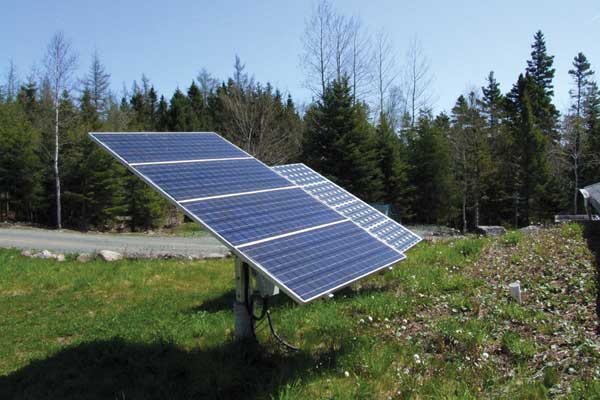
The home has eight solar panels on the south roof and two south-facing photovoltaic arrays mounted on cement at the north side of the house. (Ross says they now prefer to install panels on ground-level cement bases rather than roofs or walls.) The photovoltaic panels charge the battery bank, which goes to an invertor to convert direct current, DC, into alternating current, AC, for household use. Although the house is tied to the electricity grid, it can go for days without drawing from the grid.
Ross offers tours of his house to schools and individuals interested in seeing how the system works. He has some advice for home or cottage owners who would like to add green energy to their homes. "The first thing to do is to fix your basket," Ross says. To that end, he recommends having an energy audit done by ecoEnergy, a federal government program, to see how energy is being used, where it’s being lost and how the system can be improved. The process involves two blower tests, where air is sucked out of the house and the energy efficiency of the house is audited. The second test is done after the homeowner makes improvements, with some of the costs being refunded. Ross’ house came in at an 80 rating. Most houses rate 60; 80-90 means you’re almost self-sufficient.
Since there’s no shortage of sun in Atlantic Canada, and no shortage of expertise to harness its energy, heating your home without warming the planet has become a viable option.