
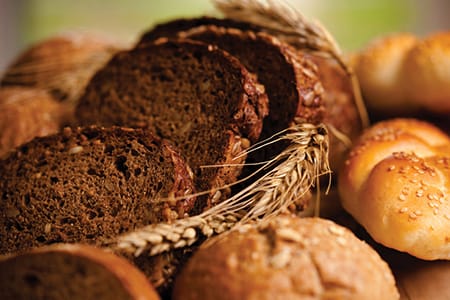
No-knead recipes take the upper body work out of bread-making.
No-knead recipes take the upper body work out of bread-making.
My grandfather worked as a cook in lumber camps and on fishing boats. When he cooked at home for his family of 10 children, he made bread by the baker’s dozen, mixing his ingredients in a large washbasin, measuring only with his big hands.
He was a thick-set man with strong arms; we sometimes called him “the Bear.” When he kneaded the dough, he pushed his full weight into it. Later, the loaves would slowly raise under the tea towels that covered them, teaching the salivating kids a lesson in patience.
Eventually, with the old Keymac oil and wood-fired oven up to temperature, my grandfather would slip the pans onto the racks. When they were done, his golden loaves of white bread would pop from the pans like miracles. He’d rub a little lard over the hot crusts to soften them.
A slice of that bread, still warm from the oven, swiped with butter and smeared with molasses tasted of love, artistry and easy confidence.

As an adult, I remember those days in my grandfather’s hot kitchen, watching the same strong hands that split the wood and skinned the rabbits knead the dough into shape.
My admiration for his skills has led to my own passion for making bread. I love giving the yeast life, mixing the ingredients with my hands, kneading and kneading… and kneading.
It’s supposed to be therapeutic in some way, but truth be told, the kneading has come to seem like more of a chore than a joy. I’ve read books on artisanal bread-making that describe ever more elaborate and labour intensive techniques. I’ve copied and perfected the techniques studiously. But the more I knead, the more I wonder whether or not it is all necessary.
Imagine my delight, then, when I discovered no-knead bread—beautiful artisanal bread without the, um …therapy of kneading. Since stumbling upon a simple recipe—one that hearkens back to medieval times, it turns out—I’ve been experimenting. After several years, I can now make bakery-quality baguettes, rustic whole grain loaves, sandwich breads, buns, pizza dough and a whole lot more with far less effort than my grandfather could have imagined.
And more recently, I came across a book on no-knead bread called Artisan Bread in Five Minutes a Day by Jeff Hertzberg and Zoë François. The book starts with a liberatingly simple master recipe, one that took a different, even simpler approach than the first recipe I was using. A little research has revealed that no-knead recipe books are popping up everywhere. The bottom line in all of them is that, while no-knead techniques require materials that may be new to you, the rule of thumb is: the simpler, the better.
Here are two basic recipes that may change the way you think about bread-making. Consider both of them places to start. Each requires special folding and shaping techniques, which come with practice. Experiment by adding whole wheat, multi-grain and other flours, seeds, herbs, whole grains, onion, olives and other flavourings.