
Exploring downtown St. John’s
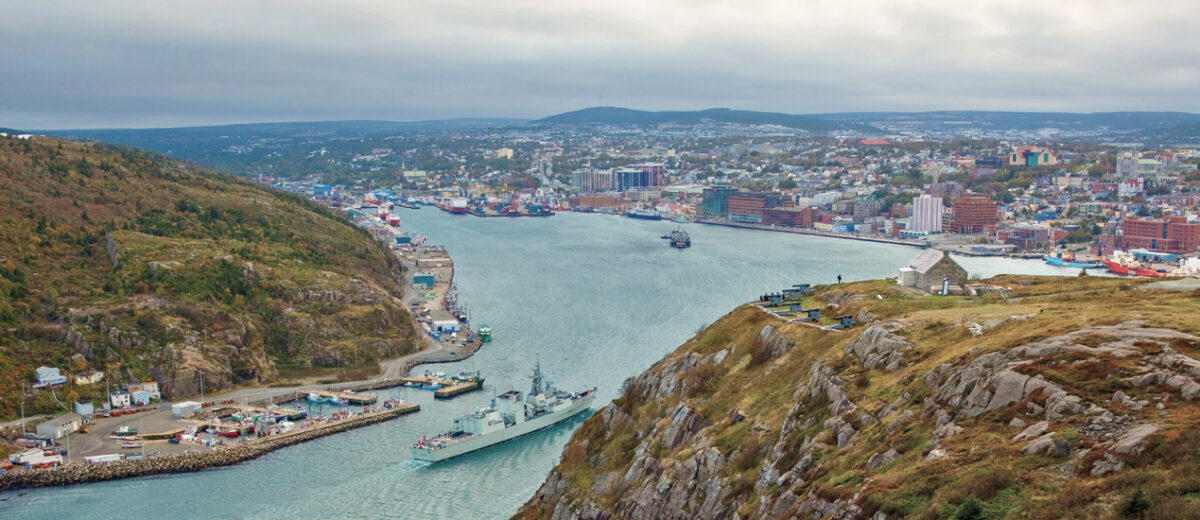
Leaning into the wind on Signal Hill overlooking the North Atlantic, one can imagine some giant knife cutting a thin slice out of the bald rock cliffs as if it was a cake. The opening into St. John’s Harbour is so slim, icebergs occasionally block the passage, known locally as the Narrows. Here on the edge of the continent, the entire downtown of Newfoundland and Labrador’s capital city is visible.
Pete Bennett and Kim Neale, visiting from Nova Scotia for the first time, found the perspective magnetic, drawing them into the scene before them. “You get a view of that part of the city, this stunning, multicoloured mass of houses and streets on the hillside, leading down to this very secure harbour with a tiny entrance,” says Bennett. “The downtown is quite distinctive from the rest of the city. It’s like a little town in a big metropolis.” The metropolitan St. John’s area has a population of 239,000, almost half of the province’s population of 550,000.
Crowning the streetscape across the narrow harbour is the optical illusion that is the Rooms. This mammoth modern art gallery, museum, and cultural centre is designed to look like three Newfoundland fishing sheds. It towers high over its surroundings, dwarfing the Gothic revival Roman Catholic cathedral a street below.
The contrast gave rise to a joke that refers to the Rooms as the box the cathedral came in.
Settled five centuries ago and incorporated in 1888, St. John’s is the most easterly city in North America. It stretches a dozen blocks along the waterfront and up four steep streets — Water, Duckworth, George, and Gower — between these two distinctive landmarks, the cathedral completed in 1850 and the Rooms opened 20 years ago. Small shops, pubs, and restaurants are scattered among colourful houses on streets residents refer to as Jellybean Row. The practice of painting houses bright colours began in the 1970s as a collective effort to spruce up what was then a rundown downtown. Today, these vibrant Victorian row houses are a tourist attraction.
In a set of façades as colourful as jellybean houses, stores along Duckworth Street hint at the variety of small businesses thriving in the downtown: Posie Row handmade gifts, the Doghouse pet supplies, Elaine’s Books, Sinaing Filipino food, Sun Sushi.

“The independence of the shops, the friendliness of the people, and the music scene” impressed Bennett. A lifelong music fan, he enjoyed browsing the vintage vinyl at Fred’s Records, in business more than 50 years, while Neale, an animal lover, was drawn to the Mad Catter Cafe, which doubles as a cat adoption centre. They were intrigued by menu curiosities at the Bagel Cafe like toutons, traditional Newfoundland fried bread dough topped with anything from molasses to cod to bologna and eggs. “That place seems an institution for breakfast on a Saturday or Sunday,” says Bennett.
A contrasting cosmopolitan, contemporary vibe defines the other end of the downtown. Big, brash rock star portraits line the walls of the Jag Hotel lobby and Zimmy’s Restaurant and Lounge on the ground floor overlooking George Street. In summer, an outdoor stage pulls pub patrons into the street. The loud surroundings fit the reputation of these few blocks as the heart of the city’s nightlife, boasting Canada’s highest number of bars per capita.
“One evening, we must have gone into three or four different bars for the music,” says Bennett.
“The downtown core was hopping and full of energy,” adds Neale. “It was way more alive than either of us expected. Downtown especially at night was so vibrant with open air music. You can hear house music. You can hear Irish music. It was wonderful for people of all ages.”
After a busy night of pub hopping, the couple needed a head-clearing stroll. Along the working waterfront where coast guard ships, freighters, and fishing boats dock, a brisk walk brings you to a fitting memorial, the Terry Fox statue. A Canadian hero, Fox ran halfway across Canada on one leg to raise funds for a cancer cure, the disease that took his life and ended his Marathon of Hope in 1980. From there, the way leads past history-evoking murals to the Battery, a neighbourhood of small houses and shacks balanced on a craggy cliff over the harbour. The challenging North Head Trail that runs beneath, then to the top of Signal Hill before returning via the road back downtown.
“We wove our way through the Battery to the start of the cliff walk,” says Bennett. “Some of the houses on stilts were wonders of construction.”
“We wanted to keep going to see what was around the next corner,” says Neale. “That’s how we ended up on the trail.” They met a few local characters along the way, including, in typically quirky Newfoundland fashion, a woman walking her poodle which was wearing a jacket emblazoned with his name — Arthur Fudge.
“Suddenly you’re on a trail that takes you into the sky,” says Neale. They found the trail that winds among the rocky outcrops challenging but absolutely rewarding.
“At one point, a mass of terns and seagulls emerged from one of the rocks in a cloud,” says Bennett.
“I felt alive that day, that’s for sure,” says Neale, “and I felt a sense of achievement.”
“We headed straight for a cold beer,” laughs Bennett.
The couple came to St. John’s for a few reasons. “Everybody said you must go,” says Bennett. “Everything I read about it said St John’s is a must-see place … Now, I just want to go back and explore more of the place.”
“I’ve had friends over the years from there, and they were such wonderful people,” adds Neale. “I wanted to see where they all came from.”