
There’s a dazzling array of meticulously handcrafted mercury glass pieces mixed with a playful pop of wartime designs in Lou-anne Wolfe’s cherished antique and vintage ornament collection.
She puts her favourites on a table, each piece presenting a soft glow in the natural light that comes with the patina of age. Wolfe says the oldest of her collection are from Europe, notably Germany, Poland, and the former Czechoslovakia.
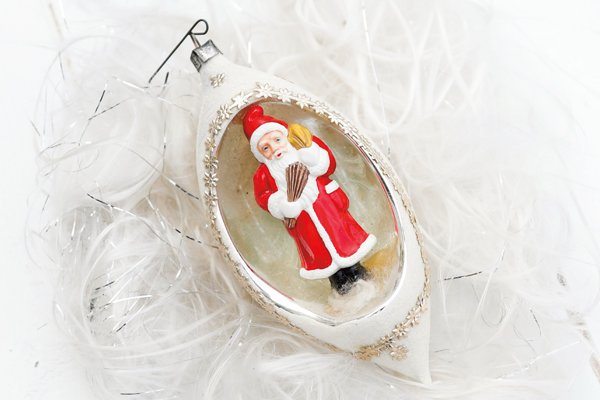
Wolfe then gently dangles one of her favourites, manufactured in Germany, by its silver-stamped cap: a teardrop-shaped blown glass bulb with a gold-trimmed opening that encases a three-dimensional plastic mould of Santa.
“Notice how it reflects.” She motions to the warm rays threading through her trellised window, bathing the 1950s ornament with a glittery snow effect. “I stumbled upon this treasured ornament in a forgotten corner of a store in Scotland,” Wolfe says.
She began her collection of Shiny Brite ornaments 30 years ago, when she discovered boxes tucked away in her century-old farmhouse. “When I opened the boxes in the attic, I was brought back to my childhood. My mother would carefully unwrap each Shiny Brite from its tissue paper, and they would take pride of place at the top of a live evergreen sentinel Christmas tree. She would not allow anyone to touch these ornaments due to the fragility of the glass ... I hoped to inherit them someday.”
Wolfe now owns more than 1,000 ornaments, the majority of which are Shiny Brites. German American immigrant Max Eckardt created the brand, including the sentimental box from her mother. But she constantly hunts for more. “What makes these ornaments so special is that someone loved them at one time and made memories decorating their home with them during the most special family holiday — Christmas,” says Wolfe.
After Remembrance Day, Wolfe eagerly takes out the boxes, cleaning each piece with a cotton swab before decorating. The ornaments don’t just enhance the medley of evergreen and artificial trees that include a Charlie Brown, a tree made of tinsel, and a reproduced Victorian duck feather tree. Wolfe says the older pieces drip from a chandelier, some nestle in wreaths, while those with wear and tear serve as trimmings in bowls or vases on tabletops. And they’re all colour-coordinated with the room.
“Ornaments have a rich and meaningful history,” says Marlene Campbell, who retired as the cultural programming coordinator in Summerside after 21 years of service.
Campbell says glass ornaments date back to 16th-century Lauscha, Germany, where they evolved from the key ingredients of fruit and nuts, threaded through the bare branches of trees, into a myriad of reinterpretations. “The folklore goes that there was a failure in the apple crop one year in Germany, and they couldn’t spare the fruit to decorate the trees. So, an artisan came up with the idea to blow a molten glass ball into an apple shape and paint it inside,” she explains.
She owns an original FW Woolworth’s box of Kugel apple-shaped ornaments, which have a metallic appearance due to their mirrored interiors, and are a reinterpretation of the original large glass balls made in Germany.
Campbell created Summerside’s annual Magic of Christmas at Wyatt Heritage Properties: Christmas Trees Through the Ages exhibition. It transported the public to the beginning of paganism and tree worship, to St. Boniface, who used the fir tree’s triangular shape to explain the trinity, and to the modern Christmas tree, and the fascinating meaning behind each of its ornaments.
Shiny Brite ornaments were born with the Second World War. Their bold, vibrant colours and silver nitrate-coated interiors, which reflect light, aimed to bring cheer amid a chapter of tragedy.
Eckardt foresaw the adversity of war on the horizon and feared that the supply chain of his hand-blown glass ornaments, shipped from Germany to the United States, would break. In 1937, he adapted a machine producing light bulbs at the Corning Glass company to create a mass medley of molten glass ornaments.
By the 1940s, American households were adding a touch of Shiny Brite sparkle, purchased from American retail giant, Woolworth’s, to their homes, including patriotic colours, complete with cardboard tops to replace the sparse metal caps.
Wolfe notes that her most cherished ornament, because of its pristine condition, is a colourful glass spiral from Germany. “It’s a rare find to be in such excellent shape... Dating around 1945. The cap is there, and it still has all the embellishments, the stars,” she says.
The value of Shiny Brites depends on how much they have been taken care of and whether they have the stamped original caps. “If you can find a mint condition box, you could pay $100,” says Wolfe.
There’s also a fresh, modern spin on hand-blown glass ornaments.
Every ornament at Glass Roots PEI, an art gallery in Charlottetown, is more than a decoration, says Rachel Fletcher. It’s a way of bringing people together and learning the ancient art of hand-blowing molten crystal. “Our creations go on to become part of treasured family traditions, woven into celebrations, remembered in stories, and passed lovingly from one generation to the next.”
Fletcher cofounded the company in 2008 with master glassblower and childhood friend, Curtis Dionne, who had trained under internationally acclaimed glassblower Daniel Vargas.
“We don’t see these ornaments as products aimed only to sell, but rather heirlooms that live on, collected and cherished across time ... They are not just symbols of Christmas, but also of who we are together,” says Fletcher.
The Glass Roots PEI golden or sand-blasted russet potato ornament, complete with a mini burlap sack, digs into the Island’s sense of humour. “Turning potatoes into glass is our way of celebrating that Islander pride,” Fletcher says. “A reminder that our culture is just as rich as our soil.”
Each Glass Roots ornament is unique. From the glow-in-the-dark classic red and white lucky toadstool, to fiddleheads, pickles, a curling rock, and Chicken Bone candy, all are created without the use of shaping moulds.
Fletcher says that the individuality of each ornament, taking inspiration from legends, traditions, and symbols, mirrors the unique way each family celebrates the holidays, evoking memories, emotions, and fostering the festive spirit of joy and connection.
“The fragility of our (glass) ornaments is a reminder of how fleeting and precious our moments with loved ones truly are.”