
McNabs Island is a brooding hunk of some 395 hectares, standing sentry at the mouth of Halifax Harbour. No longer inhabited, it is part of a provincial park along with neighbouring, much smaller Lawlor Island.
From the founding of Halifax, there were sporadic settlers and Indigenous people who used the island for their own purposes, writes author Bruce Scott in his new book The Last Farm on McNabs: A Family History of Twentieth-Century Life on the Island (Nimbus). Then, for some 50 years between the 1920s and the 1970s, McNabs was a thriving community, home to elegant homes, a military fortifications, a soft-drink bottling plant, and even a fairground. Scott’s mother Jean Farrant and her twin sister Joyce grew up on the island, born of parents who immigrated from England and farmed the land there, and Scott himself spent many a pleasurable summer there exploring and visiting with his grandparents long after his mother had moved off island. A health scare several years ago prompted him to want to put down in print some of his recollections, and those of others, who had known the island as a home.
Despite its relative isolation, there was, during those years, a thriving culture on McNabs. Those old enough to remember the Bill Lynch Midway will be interested to learn that Lynch came from McNabs, the son of the lighthouse keeper and who operated a carousel on McNabs for a few years from 1920. Finding business slow, he moved the fair to the mainland and began touring with two rides, eventually building up to a massive midway of games, performers, and rides. Many people still refer to the amusement attractions at provincial fairs and exhibitions as “the Bill Lynch midway.”
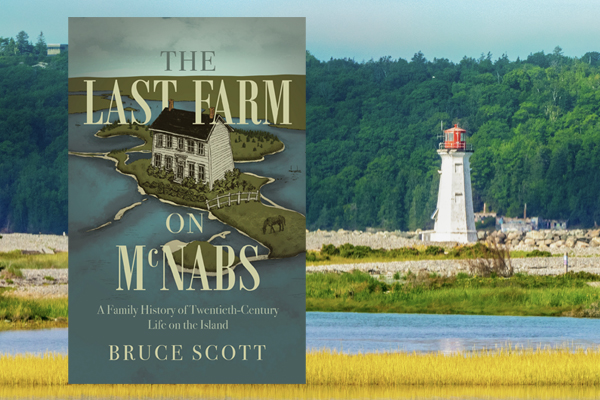 Settlers on the island didn’t have it easy. There was one telephone connected to the army base, no electricity except by battery, and no stores or services. People had to be self-sufficient, making occasional trips to the mainland for supplies, but mostly raised their own foods. Children travelled off island to attend school.
Scott has written a lively tale of a perhaps kinder, gentler time on the island in Halifax Harbour. At first, a reader might be confused by the cast of characters and how they came to be there, but Scott weaves the threads into an enticing story. He plans a sequel, with more stories of the past, including those focusing on the military contributions of his father and grandfather.
Intrigued by his story and with a new appreciation for that island in the harbour, this reader is planning to visit the island and listen to the ghosts of the past. Will we fancy we hear the sound of the carousel?