

When Peter Doig describes himself as having an “active lifestyle,” he’s not kidding. In the 2010s, as a lawyer working for Emera, the parent company of Nova Scotia Power, he regularly commuted by paddleboard from his suburban Halifax home in Jollimore to the company’s headquarters in the city’s South End.
“I did it five or six years, two to three months a year,” he says. “It took about an hour. Sometimes I’d have to navigate people rowing, and container ships, but it was fun, and I would see pilot whales, seals, and porpoises.”
So when Doig and partner Karen Crombie decided to move full-time to a property they own in Boutilier’s Point, about a 45-minute drive from downtown Halifax, they wanted a home that would complement their outdoor activities: kayaking, cycling, hiking, and wing foiling (a wind-powered watersport and one of Doig’s new passions).
They bought their cozy, century-old cottage in 2008, on a part of St. Margaret’s Bay where Doig’s family had summered for years. (His 91-year-old mother has a place nearby and so does one of his cousins.) By 2020, they were ready to move to the area, at least part time, and were looking to renovate. Crombie had retired from her position as general counsel for Dalhousie University, and Doig was looking forward to retirement too. They hired architect Lorrie Rand of the Halifax firm Habit Studio to oversee the renovation and redesign.
But while they were attached to the old house, it soon became clear that saving it wasn’t feasible.
“It was pretty quirky. It was one big room over a really scary crawl space, and then some tiny bedrooms,” Rand says. “And you could see that there was no insulation.” The building would need to be heavily reinforced and jacked up. It would be expensive, and even then, “There were no guarantees it wouldn’t collapse when they lifted it,” Crombie says.
So, workers disassembled the old place, with Crombie and Doig hanging onto some of the materials. Rand pitched them on building an energy efficient, low-maintenance passive house. Environmental responsibility is important to them and they agreed, but wanted the new build to reflect the spirit of the cottage and be well-suited to what Rand calls their “easy indoor-outdoors life.”
A passive house is “designed to operate with minimal heat input” Rand says. There is no furnace, no boiler, and in this case, no solar panels. The house is on a slab laid over eight inches of insulation (three would be standard), which absorbs heat from the large windows overlooking the bay, and radiates it back. The walls and ceiling are also stuffed with cellulose insulation (a downside, Crombie says, is not being able to hear the rain pattering on the steel roof), and a heat pump powers the water heater.
Supplementary heating comes from a propane fireplace — wood heat would quickly overheat the space — and a smattering of electric baseboards. The house has a shallow dug well and is outfitted with low-water-use appliances, which meant that, unlike many in the area, Doig and Crombie didn’t run out of water during last summer’s drought.
“In the wintertime, the heat doesn’t come on because the sun is so strong,” Crombie says. Doig adds, “Yeah, we’ll have the doors open on a sunny day in the wintertime, just to cool it down a little bit.”
Approaching the home, at the end of a series of twisty and increasingly narrow roads, some barely distinguishable from driveways, it’s obvious that Rand was successful in her effort to capture the feeling of an old cottage in a high-performance, energy-efficient home.
The steel roof is a muted brown, which doesn’t draw attention. The exterior is clad in cedar shingles — unstained, to cut down on maintenance — and a large deck and windows overlook nearby islands. They shifted the house’s orientation slightly, Rand says, to offer the best view.
Sail or paddle the waters of St. Margaret’s Bay, and you will see a lot of massive homes that seem out of sync with their surroundings. Doig and Crombie sought a different look.
“We wanted the place to feel like it had been here for a long time,” says Doig. Crombie adds, “And we wanted it to be subtle and fit in with the environment.”
The ground floor has a room with a modest TV and guest accommodations, while the main living area is upstairs, to take advantage of that stunning view.
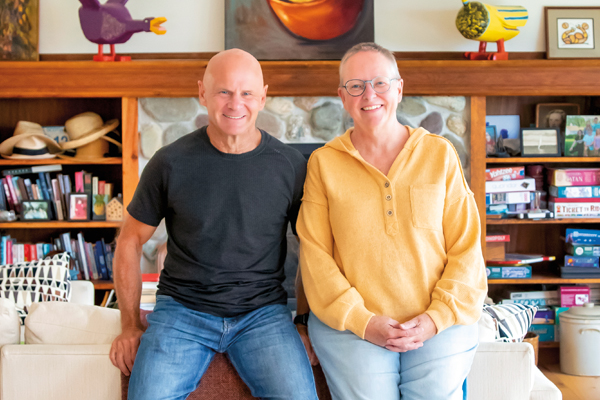
The heart of the house is the upstairs great room. Despite the high ceiling, it feels warm, welcoming and unpretentious. Meals are served on a picnic table from the old house, and shelves beside the fireplace are piled with board games. The kitchen is designed for people who like to cook, not for show, with a propane range and cabinets whose colours match the look of wood from the old cottage.
The feeling is airy, not intimidating. And that’s the way Crombie and Doig, who tend to complete each other’s thoughts, want it.
Doig: “Everything about the place was designed to take us outside. And we want to keep the style informal inside. As you say, sometimes people can get a bit precious.” Crombie: “We can’t live that way. We’re very casual people.”
Rand describes the focal point of the original cottage’s living room as a “Flintstones fireplace, with big, bloopy rocks in it.” The new home still has a central fireplace, with the original mantle, but different rocks. And the coziness of the room builds on that.
“A lot of times people do a big, vaulted ceiling and then you’re like, ‘My God, I feel like I’m trying to relax in a church,’” Rand says. “You might set the walls around the perimeter at eight or nine feet. I think we made them about seven feet, so we kept it as cozy as we could, but still gave them a bit more space.”
When they decided to move out to Boutilier’s Point, Doig and Crombie weren’t convinced they were going to live there year-round. They kept an apartment that they rent in Halifax. One of their kids lives there now, and “the idea was the apartment would give them somewhere we can go,” Doig says. But they haven’t had to use it.
“We won’t keep that place forever. We weren’t sure if we’d like the winter here or not, and whether we’d want to stay, but now we’d rather just be here,” Crombie says.