

Whether it’s Christmas, New Year’s Day, Kwanzaa, or Hanukkah, Saltscapers know how to have fun. But more than that, these celebrations are deeply rooted in beliefs and traditions we inherited from earlier generations.
Mummering is one of those celebrations. Rooted in English and Irish customs, it dates to the early 19th century. This cherished Newfoundland and Labrador Christmas tradition means dressing in outlandish disguises, often using mismatched clothes, masks, bedding, and household items, and then going door-to-door visiting homes.
When mummers arrive, the idea is to guess who’s under the costumes while sharing music, laughter, and maybe a little rum or slice of Christmas cake. Celebrating community, creativity, and spirit, mummering is a playful part of the province’s heritage.
Joyce Rideout Parks grew up in Twillingate, N.L. She fondly remembers participating in mummering as a youngster. “The week between Christmas and New Year’s Day was so much fun. We’d dress up in the weirdest costumes we could make and disguise our faces so people could try to guess our identities.”
Paula Levy grew up in Port aux Basques, N.L. She too remembers the traditions. “Dec. 23, also known as Tipp’s (tipsy) Eve or Tibb’s Eve in other parts of the island, was the usual night to mummer. But people went all over the Christmas holidays.”
Halifax-based researcher Ron Foley Macdonald notes there is also a mummer-like “Lent Break” in March in Cheticamp called Mi-Careme. It’s essentially an Acadian version of mummering, in which folks dress up and go house to house, not speaking, and waiting to see if residents can identify them.
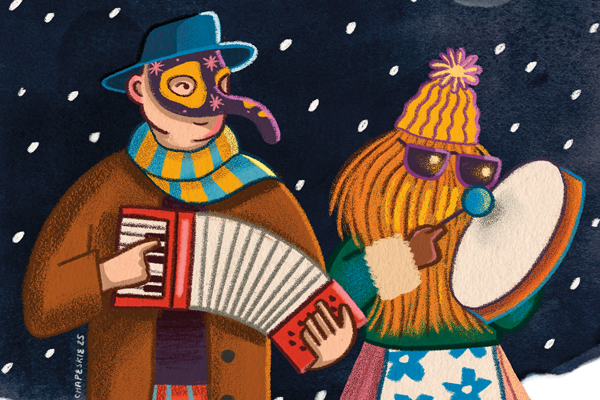
It’s quite a big deal, as is Nova Scotia’s tradition of Belsnickling, a German custom observed between Christmas and New Year’s. Cherry Workman, who grew up in Lake Ramsay, N.S., remembers the fun.
“Belsnickling had been observed for generations. It was a fun way to celebrate the holidays, and to visit family and friends. Costumes and masks were used for disguises including stuffing pillows in our clothing. A drink of rum or some sort of spirits might have been offered to the Belsnicklers when they came calling.”
First-footing was another tradition widely kept throughout Atlantic Canada, especially in the Pictou and Antigonish areas where Scottish roots run deep.
Sandi Inglis Corbin from Bedford explains. “First-footing is an old Scottish tradition about the first person to cross the threshold of a home on New Year’s Day,” she says. “A dark-haired man is the preferred first-footer, and traditionally, he would bring gifts of coal, bread, or whiskey. It was believed to be a sign of good fortune in the coming year. I read somewhere that the preference for a dark-haired man came from the days of the Vikings, when a fair-haired stranger arriving at one’s door often signified trouble.”
For the Mi’kmaw in Nova Scotia, celebrations are all about respecting their ancestors. Michelle Roy, language and culture coordinator for Wasoqopa’q First Nation, explains they gather on Dec. 21 for the Winter Solstice, a time for family, food, fellowship, and storytelling.
“It’s an important time to reset, to revaluate the past and to prepare for the new year,” she says, adding it’s also a time to pay homage to Apuknajit, the spirit of winter. “That’s when we ask for safe passage through the cold winter months ahead.”
While Saltscapers do enjoy a good celebration, no matter what you call them, they all have deeper meaning that uphold our core values and traditions.
Now, excuse me, please, as I must figure out which bed sheet will look good on me for this year’s Belsnickling.