

The Greek community on the East Coast has a rich history and vibrant presence that reflects the cultural diversity of the region. Established primarily in the mid-20th century, this community has contributed significantly to the local cultural landscape through the annual festivals, food, and traditions. The community also maintains its cultural heritage through the Greek Orthodox Church, which serves as a focal point for religious and social gatherings. With a blend of longstanding traditions and contemporary influences, the Greek community continues to thrive in Atlantic Canada, enriching the region’s multicultural tapestry. We spoke to four bakers from the Halifax community to share their memories and recipes. Celebration, food, and memory are inexorably tied together. In Greek culture, there is food for fasting, festivals, and feasts, and Christmas encompasses it all.
Melomakarona: A Honey-Soaked Season
Cookies become their own food group around the holidays, and one of the most beloved, which fills Greek homes during this festive time, is melomakarona. What sets these cookies apart is their soft yet crumbly texture and irresistible honey syrup soak. Traditionally, the cookies are made during the Christmas season because they symbolize abundance and joy.
Melomakarona date back to ancient times, when they were associated with the winter solstice and the celebration of life. The word melomakarona is a combination of two words, meli, which means honey, and the ancient word makaria, which means blessed. The use of honey in the recipe is particularly significant because it represents prosperity in the coming year.
Baking melomakarona is a festive tradition for many Greeks, including pastry chef Konstantinos Organtzis. A sort of alchemy happens when the cookies submerge in fragrant honey and orange syrup, transforming them into sticky morsels of delights.
“I’m from Thessaloniki, the second largest city in Greece, with a rich culinary tradition because of its cultural diversity,” says Konstantinos. “My grandfather, Konstantinos, used to have a small café in the 1970s and created mezze and baklava desserts for his customers. So, my mom, Maria, learned everything from her parents, which made her a great cook and kept the culinary tradition in the family.”
He remember being around the kitchen, watching her cook and bake, asking questions and dipping fingers in the honey syrup and icing sugar.
Recipe: Konstantino’s Melomakarona.
Kourabiedes
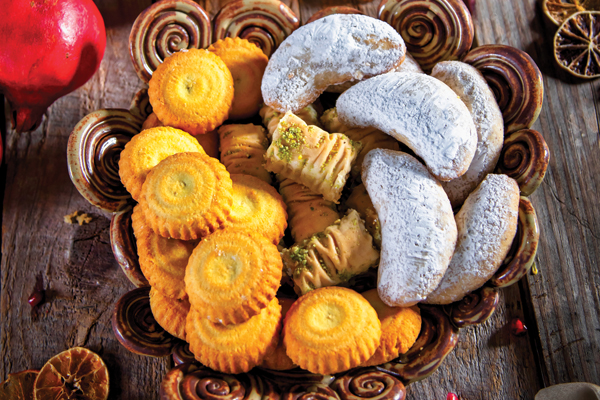
Their signature melt-in-your-mouth texture and sweet, nutty, buttery flavour dusted with mounds of powdered sugar make kourabiedes one of the most beloved and instantly recognizable Greek holiday treats. While recipes vary by family, most contain Metaxa brandy or ouzo, vanilla, and a hint of rose water.
Kourabiedes go back to the Ottoman Empire, where similar cookies were made. The name derives from the Turkish word kurabiye, which refers to a type of cookie. In Greek tradition, these cookies symbolize celebration, and legend has it that during Ottoman rule, kourabiedes had to be made into crescent shapes, a tradition that still prevails around Christmas.
“Whenever I think of Christmas, my mind is filled with memories of my mom’s kourabiedes,” says George Tasiopoulis. “I remember her taking a day off work, or an entire Saturday, to bake kourabiedes and other sweets in preparation for the holidays. It’s a tradition that she, my sisters, my niece, my wife, and my daughter still uphold each year. The joy of baking and sharing these cookies is a true reflection of the warmth and togetherness of the holiday season.”
Skaltsounia
These egg- and butter-free pastries, filled with a mixture of walnuts, spices, figs, and honey and enrobed in a delicate pastry, have been part of Greek Christmas celebrations for generations and are eaten around the Nativity fast before Christmas.
Skaltsounia, sometimes called “kalitsounia,” have their roots in the Aegean Islands, particularly Crete. Skaltsouni means “little pie” in Greek, and the origin of these treats can be traced back to Byzantine times when similar pastries were offered during festive occasions. Over the centuries, different regions in Greece have added unique twists to the recipe. The Cretan version, for example, often includes fragrant herbs like mint, while other variations lean heavily on rich nuts and spices.
For Athena Katsaros, baking skaltsounia has remained a strong connector to her Greek grandmother.
“Along with Melomakarona, this jammy fig cookie reminds me the most of my Yia-Yia. I remember being in her tiny kitchen in Patras, flour dusting the countertops, and her infectious laughter filling the kitchen. As we mixed the dough and rolled it into thin rounds, my Yia-yia shared stories and memories of her youth,” says Athena. “She never measured a single ingredient, and the recipe was never written down because she never learned to read. We would eat the first few together, and Yia-Yia would always dunk hers in a little glass of ouzo.”
Vasilopita
As the new year begins, most Greek families prepare to celebrate with Vasilopita, a rich, sweet cake often adorned with a coin. It’s not just a cake, it’s a symbol of new beginnings and the spirit of generosity that defines the season. Vasilopita is typically made with simple ingredients like flour, sugar, eggs, and butter and can be flavoured with hints of vanilla, orange zest, dried fruit, nuts, or chocolate.
Vasilopita translates to “Basil’s cake” and is named after one of the most beloved saints in Greek Orthodox, Saint Basil the Great. The cake is baked on Jan. 1 to honour the saint’s feast day on Jan. 2. Vasilopita is steeped in folklore. According to legend, Saint Basil collected taxes from the wealthy to distribute among the poor. To protect a portion of the money collected, he baked it into a cake, hiding the coins inside. When the cake was served, each family member received a piece, and whoever found the coin was blessed with good fortune for the year ahead.
“It’s probably the only time of the year that every woman in my family is gathered in the kitchen. We all come together to prepare Vasilopita: my mother, two daughters, three nieces, three sisters, sister-in-law, and this year my first grandchild will join us,” says Maria Papadopoulos. “It’s a tradition my mother passed onto us when my sisters and I were young and had just immigrated to Halifax from Athens in the early 1990s.”
They rotate kitchens each year, but the recipe is unvarying.
“Once the batter is mixed, the real fun begins,” she adds. “Each year, one of us carefully places a heavy coin wrapped in foil into the batter before baking. After the cake is baked and decorated, my mother recites a blessing before cutting the cake into slices. Three pieces are always held back: for Christ, the Virgin Mary, and the home.”