
Newfoundland and Labrador vernacular always gets right to the point.
It’s in this vein that Labrador’s Them Days magazine, this year celebrating its 50th anniversary, found its durable, endearing title from the moment it was knitted.
It all began with Cartwright native Mike Martin, known for spending the “better part of his life advocating, agitating, even badgering anyone in power to gain recognition and better treatment for his beloved homeland and its people,” according to an article by 30-year veteran CBC broadcaster Bruce Bourque for the magazine’s September 2025 anniversary celebration issue.
In late 1972, Martin, noteworthy for having created the Labrador flag, approached Labradorian Joe Goudie suggesting the formation of an association aimed at preserving the region’s history and culture. The Labrador Heritage Society was born, comprised of Martin, Goudie, Goudie’s mother Elizabeth, Bourque, Dave Lough, Bernie Heard, Gilbert Learning, Selby Learning, Isaac (Ike) Rich, and Bella Brown.
The new society contacted the Happy Valley-Goose Bay’s Old Timer’s League, a group the federal New Horizons for Seniors program already funded. The league agreed to apply for and got a new $3,000 grant to get the magazine off the ground.
By 1975, the society found its first editor, Doris (Martin) Saunders, who, with her new employers, discussed options for the magazine’s name over a series of meetings.
Bourque remembers the obviousness of the choice when it presented itself. He can’t recall if it was Saunders or Rich who remarked, “You know, all the people I interview, their stories are peppered with the phrase ‘In them days’. Maybe we should call it ‘Them Days’.”
“All around the table we looked at each other,” says Bourque. “Eyes wide. That’s it. I’ve always thought it was the perfect title because not only did it immediately advertise what the magazine was about, but the use of ‘them’ instead of ‘those’ gave it an unmistakable flavour of people’s stories in their own words. The name said we are ‘of the people’.”
Saunders died in 2006 after 30 years at the helm, having shepherded the magazine from its inaugural 64-page launch through more than 100 regular issues, plus double issues and special publications.
In the beginning, Saunders wrote the stories, with Bourque volunteering for the production process, working by hand using sheets of dry-transfer lettering known as Letraset (a tedious, earlier print production technique). Fellow volunteer Nigel Markham, then a cameraman at CFLA-TV and an experienced photographer, managed the photos. But it all centred on Doris. “Without Doris, it would have failed,” Bourque says.
Them Days flourishes today under the watchful eye of Aimee Chaulk, a 17-year successor to Saunders. It operates with no advertising base, earning revenue from about 400 subscriptions, retail sales, and donations.
After attending Ryerson University and coming home to Labrador to work at the Labradorian newspaper, Chaulk applied for the job of Them Days’ editor. She recalls being asked during her interview what she would change about the magazine. She went out on a limb, declaring, “nothing.” This turned out to be the perfect answer.
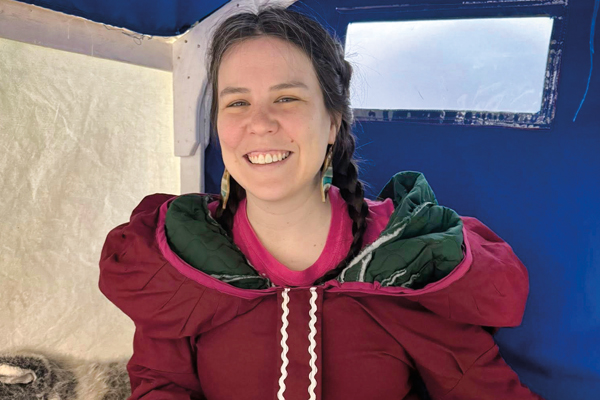
“In 2008, I walked into the Them Days office for the first time. It was a cold, dark winter’s night, my feet crunching on the snow and my heart beating. For me, this was a big deal. A really big deal. A collection of Them Days magazines always sat in a prized location on a bookshelf at my house growing up, no matter where we moved.”
One thing that has changed about the magazine over time is the generational subject matter.
“I have to interview folks who are now much younger than the elders who were in the magazine in the past,” says Chaulk, “people who could maybe remember back to the turn of the century, and further back if they were telling stories they’d been told by their grandparents.”
Many current subjects incorrectly think of themselves as being too young for a Them Days interview.
One of those involved in the magazine from the get-go as well as today, is Dave Lough, no stranger to various frontiers of Labrador cultural and heritage. “Them Days has survived through a deep passion and love of place,” Lough says. “However, we are in a different era. The regions of Labrador are isolated now politically rather than geographically. This provides challenges but also opportunities for Them Days as we move into the next decade,” attracting public and private sector support, as well as new subscribers. “Succeeding at this is a strong affirmation of the value that the publication has for the Labrador of the future.”
Them Days is much more than just a magazine, including the archival work of digitizing Labrador photos and documents, and publishing research and essays on the region.
Chaulk says it’s the spirit and drive of the magazine’s originators that she strives to live up to every day. “I work to continue the decolonization of records and to normalize and value Indigenous knowledge,” she says, adding that she strives to “amplify the voices of Labradorians and to shine a light on histories otherwise forgotten.”
All the while, the definition of “them days” evolves.
“I hope,” says Chaulk, “that we can continue to reflect on our past with the same enthusiasm and desire to see ourselves as we are.”
Pull up a chair
The Them Days office is open to the public, welcoming visitors to read the magazine or research in the archives at 3 Courte Maunche St. in Happy Valley- Goose Bay, just around the corner from the Labrador Friendship Centre. Drop by from 8:30 a.m. to 4:30 p.m. on weekdays.