
It has sat here at this crossroads in Stanhope, on the North Shore of Prince Edward Island, for almost 150 years, but with your mind focused on choosing the right direction out of the roundabout, you could easily overlook the small white building. If you did look at it, you might just as easily miss the arches over the door and windows that identify it as a church.
Inside, the building is no more distinguished. The floor is covered with industrial carpet and the walls are panelled. You might be able to squeeze 125 people in the pews.
But something remarkable is happening here.
A dark-haired woman sits at a parlour piano. A half dozen women sit in plain wooden chairs with red seat cushions. There’s a lot of laughter as they sort through the loose papers they hold. A woman with a violin sits in the front pew. Then the pianist runs her fingers over the keyboard.
“Are you ready?” she says.
Even this short phrase gives away that she’s not from here, but before you can reflect on her accent, she plays a short introduction then the voices of the little choir fill the building. They sing a verse and the pianist stops. She claps her hands to indicate the rhythm of a particular line, not everyone in the choir reads music, and they try again. Conducting with her head, she moves on to the next verse. She indicates a change in the melody by moving her left hand up and down while playing with her right. The finale is tricky, and she runs through it several times before she says, “Good!”
Weekly choir practice was once common in churches around Atlantic Canada. “Living, breathing, singing choirs are becoming very rare,” says Kathryn Dau-Schmidt, the fiddler in the front row. “To me it’s really important that, at least in these little churches, we can maintain an actual human choir.”
It is a tradition that, but for an ongoing tragedy on the other side of the world, may have fallen apart at Stanhope United Church. In December 2023, Margaret Power, the church’s musical director for 39 years, told Rev. David Atwood that she was leaving the position for health reasons. It could have meant the end of music at the church, but one of Atwood’s parishioners knew a potential successor.
“We hardly had time to think about it,” says Atwood. “Within a week or two of Margaret saying she couldn’t play, we connected with Tetiana.”
Tetiana Kirienko brings 40 years of experience as a working musician in Ukraine to this rural Maritime community. She left her home in November 2022, fleeing the Russian invasion, joining her son in Charlottetown. While her musical experience is vast — as a choir director, accompanist, and piano teacher — her lack of English was a barrier. During her first year in Canada, it was hard to form relationships.
“It was very difficult for us because (in Ukraine) I had a job, I had many, many things. I have apartment, I have a job, I have a salary. But nothing here,” says Kirienko.
She took English classes at Holland College, where she met the Stanhope parishioner who approached her about the music director position. To be offered work as a musician was a dream come true, but also frightening. How could she lead a Canadian choir when her English was rudimentary? She took some convincing, she says.
“First time, yes, it was very, very scary,” recalls Kirienko.
But, says Dau-Schmidt, her concerns were misplaced. “She could always tell us what she wanted, whether it was English or by demonstrating or something else,” she says. “The music is a language too.”
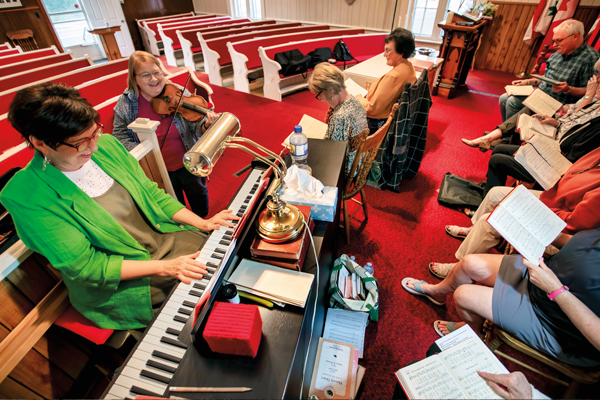
The support Kirienko found in this community is clear. If she struggles with English to tell part of her story, choir members pipe up to clarify. They’re proud of their choir director and the work they’re doing together.
Churches often describe themselves as communities and Atwood says the choir is a community within it, one that helps bring that larger group together.
“When we get together and practise, we connect through the music,” he says. “That connection happens early on a Sunday as well. It’s really important to have that centre, that centre of the community.”
Music helped her through that difficult first year in Canada, says Tetiana, and has now helped her find a place here. “The music helped me, always, and now I feel better because I have my company, my young girls,” she says, to laughter from the grey heads lined up along the back wall.
Kirienko hopes this is just a start. She has two piano students now. “I will have a job, teach the piano, maybe. I know, accompanists, (there are) not very many openings. But we will see,” she says.
You might have suspected, if you had made note of this building as you drove past it, that this small church in a rural Island community was populated by locals who could count generations of parishioners among them, but that’s not the case at this choir practice. Margaret Power, Kirienko’s predecessor, came to the Island from Ontario. Dau-Schmidt grew up in the American Midwest and immigrated to P.E.I. in her mid-20s. She had a similar experience of connecting through music.
“Like Tetiana now, when I got here, I wanted to contribute something,” she says. “I wanted to be part of the community, but I wanted to contribute something to the Island, too. And music is a big, big part of this Island.”
Dau-Schmidt went through her own struggles when she moved to the Island. But she has made her impact. Her former students include Richard Wood. She was named a member of the Order of P.E.I. last year for her work preserving traditional fiddle music on the Island. She feels Kirienko can make an impact, too.
“Tetiana has a lot of skills that she could contribute to P.E.I. that we could use in a variety of places, not just choirs,” she said. “Through the music we can all come together. And it was the same when Tetiana first came here, and she was worried about her language. But the music, we all understood the music.”
But it is not just about the music, says Atwood’s wife, Margaret. She and her husband also come from away. He’s from Bermuda and she’s from the U.K.
“I don’t think that this community fully appreciates how welcoming they are and how unusual they are in the way that they welcome newcomers in. They make us feel as if we belong,” she says.
It’s not just the music, it’s also the laughter, which rings out at Stanhope United Church choir practices almost as much as the music does.